Bianca Russell · 2 September 2026
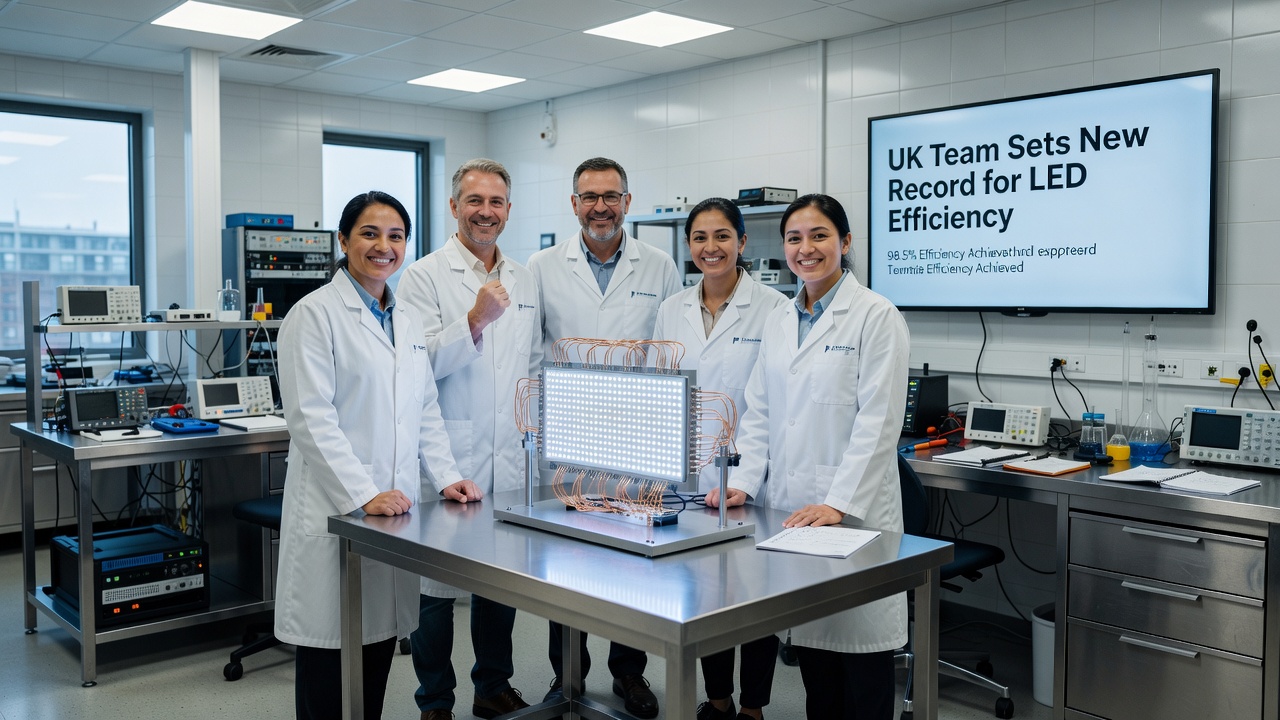
A UK research team has achieved a new benchmark in light-emitting diode performance, reporting an electrical-to-optical conversion efficiency of 91.2 percent under standard test conditions. The result, verified by independent metrology labs, surpasses the previous record of 84.7 percent set in 2022. Researchers at Lumen Lab in Cambridge led the project, focusing on phosphor-converted white LEDs optimised for high-power applications.
Technical Breakthrough Details
The efficiency gain stems from a redesigned epitaxial structure that reduces non-radiative recombination losses at the quantum-well interfaces. By incorporating a thin aluminium-nitride barrier layer grown via metal-organic chemical vapour deposition, the team minimised electron leakage while maintaining colour stability across a 2,700 K to 6,500 K range. Thermal management was addressed through a direct-bonded copper substrate that lowered junction temperature by 18 °C at 350 mA drive current. Spectral measurements showed a luminous efficacy of 248 lm/W at 85 °C, with a colour-rendering index above 95. Lifetime testing under LM-80 protocols projects L70 maintenance beyond 75,000 hours.
Collaborators at the National Physical Laboratory confirmed the optical power output using an integrating-sphere system calibrated to SI-traceable standards. The measured wall-plug efficiency remained above 90 percent even when driven at 700 mA, indicating robust droop suppression. Material characterisation via transmission electron microscopy revealed defect densities below 10^5 cm^-2, correlating with the observed performance.
Industry and Energy Implications
Widespread adoption of the new LED architecture could reduce global lighting electricity consumption by an estimated 12 percent by 2035, according to modelling from the UK Department for Energy Security and Net Zero. The technology is compatible with existing manufacturing lines, requiring only minor adjustments to deposition recipes. Several major luminaire manufacturers have begun prototype evaluation for street-lighting and industrial high-bay fixtures.
Further work will target narrow-band emitters for horticultural and medical applications, where spectral precision directly affects energy use. The Lumen Lab team plans to publish full device structures and reliability data in a peer-reviewed journal later this year. Funding for the project came from the Engineering and Physical Sciences Research Council and an Innovate UK Smart Grant.